Wednesday, July 1, 2009

Happy Belated Birthday, Carroll Baker

I'm over a month late on this, but Carroll Baker turned 78 last month, and I wanted to note this momentous occasion. Baker was a sex symbol back in the '50s, making an Oscar-nominated splash as the eponymous Baby Doll, and having a respectable career into the mid-'60s. Then she went off to Europe and did a bunch of Giallo films before returning to America in the '80s and '90s to do a whole bunch more parts.

A working actress, in other words. Our favorite kind here at the 'strom.

Astonishingly, though despite vamping her way through the height of the pointy-breast era, I couldn't find a single picture of her in a torpedo bra. In fact in a world of Monroe rip-offs, Baker was a modest, marvelous B-Cup.

Well, what do you think?
Not bad, eh? Elisha Cuthbert bears a superficial resemblance, but we'll see how Cuthbert's doing in 2060. Er, well, those of us still alive, anyway.

Tetro Fish

One of my favorite movies is Apocalypse Now. I love it, right down to its murky ending. So much so that I've never been able to bring myself to watch Apocalypse Now Redux, the mega-expanded hour-longer version for fear it will make me reject the whole project.

My old martial arts instructor, with whom I used to have hours long bull sessions after class, rejected it as a "film student project". And the thing is, I can't really argue with that perception of it. It's a bold movie, and if it fails in your eyes, "film student project" is a fair description.

Last Sunday, I dragged The Boy out to see Francis Ford Coppola's latest film, Tetro, and if you had that idea that Coppola inclined toward that sort of "film student project", this is not going to be the movie to disabuse you of that notion.

There are two things I can say for sure about this movie:

1. It is positively gorgeous, a sheer masterwork of cinematography, light and shadows, blocking, and composition with nary a throwaway shot.

2. At about two hours, it is overlong by about 20 minutes.

The story is simple: Young Bennie (played by Alden Ehrenreich in a role Leo DiCaprio would've done ten years ago) goes to Buenos Aires to track down his older brother, Tetro, who fled the family many years earlier with a promise to come back for him, but who never did.

Tetro has become a famous writer who doesn't ever write or publish anything, but seems to be very well liked and respected in his own modest way in this little corner of the city known as La Boca. He has a faithful girlfriend-not-quite-wife, and in his not-quite-functional way, he's living a good life.

The imbalancing effect of Bennie is two-fold: First he knows nothing about his own history, so he digs through Tetro's autobiographical play; second, Tetro's friends know nothing about Tetro's past, so Bennie reveals truths to them Tetro wanted to keep hidden.

This all unfolds in glorious black-and-white, except for the flashbacks, which are in color (and a 4:3 format instead of 16:9?), and we slowly get a picture of the dysfunctional family the two are from. A little too slowly, really, since I figured it out at the start of Act III.

So, besides the length, this movie is both very meta- and very "inside baseball". First of all, it's littered with shots that, if they aren't famous from other movies, feel like they ought to be. Coppola can (and does) do that. It always feels more like he's painting from the same palette as the masters versus ripping them off. But unlike, say, Bram Stoker's Dracula, where it was almost necessary to know all the films he was riffing off of, this stuff just works.

But this is about the struggles of a very creatively talented family. Their dysfunction manifests in the expression of their art: The play Tetro can't finish; the life Bennie can't begin; and the patriarch who is not satisfied with his own greatness unless he can grind everyone else down. It's not necessarily something everyone can relate to.

Even more problematic is that Tetro and Bennie bonded through Tetro exposing the younger boy to arty films, and segments of the third act play out as dance numbers that hearken back to one of those films. I'm talking ballet-esque bits with real dancers (not the actors). One was interesting; three was probably excessive.

One thing that Coppola has over most of the "film student" types is an inherent upbeat nature. His movies, no matter how dark the subject matter, tend to be an affirmation of life. And so, while this movie looks very noir, it doesn't wallow in darkness.

That's probably why I like it. I really wouldn't recommend it to just anyone. And we picked a bad time to go see it, too: The show started after 10PM, and we were both wiped out. The Boy couldn't decide if he was having trouble getting into it, or if it was just bad. (Keep in mind that he couldn't sit through Vertigo the night before with the same issue. He had a restless weekend for various reasons.)

Other things to appreciate in this movie include the acting, with young Ehrenreich doing fine work, Vincent Gallo doing what he does, Maribel Verdu just perfect as the devoted not-wife, Klaus Maria Brandauer as the patriarch, and so on. The music is perfect.

But even so, I know a lot of people would consider it boring, pretentious, overly arty, and so on. I was won over by its basic good nature, and skill in execution that you just don't see any more. You might not be.

Tuesday, June 30, 2009

Another In A Series Of Immodest Proposals Entitled "A Modest Proposal" For Satirical Value

California passed a vindictive little bill designed to limit elected representatives' salaries. I'd say it was fiscally prudent, but it really won't make a difference in the long run. Still, I suppose I should give us credit, since for my entire voting history we've done nothing but vote for bond after bond to pay for program after program.

I think the bill requires that the budget be in place or something--we have a hard time actually getting budgets out, because we have so many massively powerful special interest groups to feed: teachers, other government employees, illegal immigrants, etc. (And I have no idea how illegal immigrants get to be a powerful special interest group but, here we are.)

A better idea, however, would be for the politicians to only be able to collect their salaries from what was leftover in the budget. Run a deficit? No money that year. Hell, we should have them give money back at that point. Sell your homes and cars, people. Send your kids to public school. You're on a budget this year.

They'd find a way to screw it up, of course.

They always do.

Weird Science

We were back at the dietitian's last Friday after a couple of weeks away, and both I and The Boy were dehydrated. Not a huge surprise, really: We'd been walking around the college, in the heat, I'd been working out a bit more, etc.

As a coda to this post about my weird dream, the dietitian was giving us signs of dehydration to watch for, so that we would know when to drink extra water. First one she mentions? Weird dreams. General sleep disturbances (I hadn't been sleeping well, or at least not long enough.)

So far, though, everything that she said would happen has happened. We had some blood sugar crashes early on (as The Boy's body released the artificial insulin it stored up) and then, in line with his graph being in the right place, he's started to have sugar in his urine.

Generally, you don't want sugar in your urine, but in this case it's supposed to be indicative of the healing process. Intriguingly, The Boy's sugars are very well in control, if a little wild. (They'll get suddenly high, then drop down just as suddenly, though never into a dangerous zone.) He's also on half the per-meal insulin he was a few months ago.

The theory is that artificial insulin is like a cast for the pancreas, so once the body starts healing, you need to take the cast off, letting your sugars get a bit high so that the pancreas will be stimulated to start producing.

I'm sure this could cause a panic attack in a lot of medical professionals. I'm sure it's dangerous. But you know what? So is diabetes-for-the-rest-of-your-life. They kind of feed you a cock-and-bull story about how you can be in the NBA and live a normal life, but the long term consequences for a diabetic, even one with well-controlled blood sugar, are really pretty horrible.

I love mainstream medicine, don't get me wrong, but really only for emergencies. Bad infections, broken bones, heart attacks, and so on. But if I have high blood pressure, I don't want to take a pill forever. I want my blood pressure back to normal. Same with high cholesterol.

But even if you're an all-mainstream-medicine-all-the-time-guy, the FDA sits on drugs that might help people in the name of protecting them, essentially protecting them to death. "Excuse me, Mr. Government, sir, but I'd like to try that cancer medicine, even if it might kill me. Because I'm going to die anyway."

I think Man has an inalienable right to his snake oil, as I've said here many times. I'm sure, in my case, that it's part of the pursuit of happiness. And in everyone's case, it's a matter of sovereignty over his body.

If the government would leave my body and my property alone, I'd be happy to have the social liberals and conservative battle out whatever they wanted.

Last Night I Had The Strangest Dream

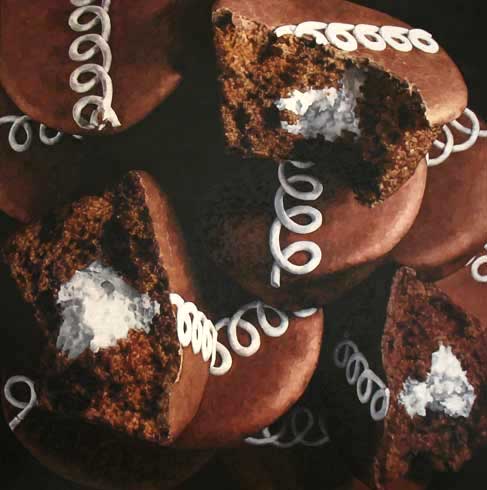
I don't generally dream. (See footnotes.) Last week, though, I had a strange dream where I went to buy a package of Hostess cupcakes from a vending machine in one of those big banks of machines. After having some difficulty putting in my money, I realized there was already credit on the machine, so I got myself some free ones.

Then I noticed that all the machines were just giving out their wares and I methodically started emptying the machines out, carrying so much junk food that I was dropping it.

And, as is always the case with my transgressive dreams, I felt guilty.
  • I don't like most junk food, including Hostess cupcakes.
  • I can't eat stuff like that right now anyway.
  • I was stealing.
  • And I was stealing cheap things.
I mean, like my Pappy always used to say, it's one thing to be bought, it's another thing to be bought cheaply. (He always talked about that in terms of people stealing office supplies.) And finally, perhaps worst of all:
  • I knew I was dreaming.
When I was about five or six, I had a nightmare, and I went--as children do--into my parents' bedroom. They were still awake and my father was rather annoyed. When I told him it scared me, he scowled and told me it was my dream, so I was in charge, and stop wasting his time with such nonsense.

This, perhaps surprisingly, was effective. (At least with me. I've never been able to sell my kids on it.) And the upshot is that when I do dream, I'm always aware that I'm dreaming. I've never had any kind of extended nightmare since, because I'm aware that I'm in charge of what happens. This eliminates any sense of fear. (I did have a night terror once, though. That was amazing.)

The opposite side, though, is that I also always carry whatever moral baggage I have into my dreams: So I can't engage in any of the wanton behaviors that we're generally prohibited from engaging in in day-to-day life. So, not only could I not steal in my dream, I couldn't even bring myself to eat any of the junk food. Which is a shame, because I could've enjoyed dreaming of eating it, even if the reality would've been disappointing. I even had a pretty good mental justification worked out, since I've been robbed by so many vending machines over the years, I figured this was the cosmic karmic scales finally balancing.

But I shut the whole thing down when I found myself trying to figure out how much money I should leave to compensate the vendors.

Sad, really.

This is part of the reason I don't dream: no percentage in it for me.

Footnote: And for those of you pimping the idea that everyone dreams, I say prove it. I don't deny that I go into REM sleep, of course, but I am unconvinced that that necessitates having a dream. The whole "you dream, but you don't remember it" strikes me as unfalsifiable.

Free To Be?

Darleen Click at Protein Wisdom links to a story on a couple raising a child as an "it". I had some relatives--conservative Christians, no less--who were enamored of the "Free to Be...You and Me" thing back in the '70s. I was pretty young when I first heard, and I found it sort of creepy for some reason.

Which isn't to say that I didn't believe that gender stereotypes might not have been instituted or unduly enforced by social norms. Or don't, even. Obviously society is an influence. And as I've said, a sane society would encourage norms while tolerating outliers.

I mean, logically, one can loosen certain social restrictions when the mere basics of survival are not at risk, right? Maybe not, but the most easily recalled situations always seem to involve chucking morals out the window. And society follows.

But the '70s did a number on kids. A lot of girls grew up believing that the traditional female role--mother, wife, caretaker--was an unworthy pursuit. In other words, the "liberation" of women worked out to recasting them into yet another rigid mold which didn't even have any of the biological imperatives as an advantage.

This can be seen in lots of other areas as well, of course. Ending racism didn't actually mean ending racism, it meant changing who it was okay to be racist against. Sexual liberation didn't mean freedom to not be promiscuous. Indeed, few things (if any) sold as "freedom" in recent years have actually amount to more freedom.

I was sitting around the table with my mother and stepfather and sister this weekend, and all of us had, at some point or another, believed to some degree or another in an undue influence of society on gender. But as we watched The Flower and my nieces play--they had set up a dress shop, cobbled together with two decades of toys from various grandchildren--expressions of both femininity and entrepreneurism were as natural as breathing.

And this is with two completely different styles of parenting. My nieces were actually raised in some kind of limited tech Quaker-type community until recently. I've always encouraged the more masculine aspects of my daughters because, well, I'm a guy and that's what I know, but also because I think it's good for them.

So far as I can tell, all these girls are as girly as they started out.

And I daresay, we, all of us, felt a little cheated by this unsupported bit of dogma (society is the sole arbiter of gender roles) masquerading as enlightenment, expressed and regurgitated in so many different ways over so many years.

But I think this next generation is going to be themselves, no matter how uncomfortable their transgressive insistence on being very definitely male or female makes the old folks.

Monday, June 29, 2009

Manic Monday Apocalypso: Flash Gordon Conquers The Universe!

My parents were of the Saturday matinee generation, where a nickel (or was it a dime?) would get you into the movies at the crack of dawn and entertain you till dusk. (And, oh, where to begin with the analysis of cultural shifts in that slice of Americana?)

My mom was a big fan of Buster Crabbe, though she surely must have seen the reruns of the serials since she was too young (or not born) for the originals. And when I was young, we had a UHF channel that would show a variety of old, old, really old or unpopular stuff like the late '50s black and white "Felix the Cat" cartoons (compared to the bigger stations' WB and MGM 'toons), the "Life of Riley" (versus "I Love Lucy"), silent movies (I watched Nosferatu and Metropolis this way) and serials like "Flash Gordon Conquers The Universe".

I loved this show. Even as part of the Star Wars generation--or perhaps especially because--I loved the rockets on strings, with sparklers in the back, the cheesy composed shots with giant geckos sorta-kinda chasing tiny humans, the guys with the vampire fangs or gorilla suits.

I have this box set of the serial, though if you dig around at Archive.org, I'm sure you can find it. (And feel free to notice that the #1 staff pick is an anti-Bush film by MoveOn.Org. There's no escaping this crap, is there.) I should say that I'm referring here to the original Flash Gordon serial, not really "Flash Gordon Conquers The Universe".

In the original serial, the planet Mongo is flying through the universe and headed on a collision course with the earth, which it will apparently destroy at no significant harm to itself. Burning meteors are dropping from the sky (at alarmingly slow speeds) and this causes the plane that champion polo player and Yale man (really!) Flash is on with Dale Arden to, uh, be in danger somehow.

Fortunately, they all have parachutes except Flash who hangs on to Dale on the way down. (Pleasure to meet you, ma'am!)

They happen to land on the lawn of crazed scientist Zarkov who has built a spaceship that he's going to use to land on the renegade planet and try to talk some sense into the driver.

At the helm of said planet is Fu Manchu's twin brother, Ming the Merciless, who very practically decides to put Zarkov to work in his labs (and in a space-onesie!), give Dale the "fate worse than death" and kill Flash. (Can't use you, man! Got enough dumb thugs in security as it is.) The princess, Aura, has other ideas and rescues the hunk of man from various fates worse than--no, that actually are death.

From there on, Flash meets the other colorful members of Ming's empire. And, I don't want to give anything away, but he does get out of a lot of tight spots.

I think what entertains me the most about the serial is probably the Art Deco influence. Just like the original "Star Trek", where everything is all hippied out in post-modern (?) style, and the '80s series features oodles of big hair and, well, very '80s-looking design. I don't know if it's just the lapsed time between Art Deco and now, or if it's that Art Deco is just that much cooler than all the intervening styles.

I mean, seriously, the '40s, '50s and '60s styles have their moments, but there's a lot of ugly in them, at least to my eyes. And my opnion hasn't changed much over the decades. '70s style, of course, was both uniquely ugly at the time and still ugly today. I am painting with broad strokes, of course, as there are always good things around, but to my eye the Art Deco style of the serial--the curved ships, the rays coming off Ming's throne, etc.--give it a flair that outshines the cheapness of the sets. (And is completely missing from the '50s version, to its detriment.)

I actually liked the 1980 remake, which was surprisingly faithful to the original. It's campy, of course, but intermittently so. Sometimes it is genuine in its earnestness. It also captures the strangely small feeling of space in the series, and eschews realism for a more colorful, interesting "space".

Of course, these days, most people remember Freddy Mercury's song more than anything, and probably with good reason. Mercury could sell it.

Well, until next time, mutants, stay radiated!

Sunday, June 28, 2009

Brunat

Last week at the movies, there was an ad for Michael Moore's latest thing. I used to be a fan of Moore's, actually. Roger and Me is a brilliant bit of propaganda as, I suppose, most of Moore's work is.

What turned me against Moore wasn't really politics. It was his show "TV Nation". On an episode of that show, he did a story about a hospital where uninsured people who had received services were allowed to pay off their debt by working for the hospital. The people involved were happy with the program, patients, doctors, administrators alike.

Moore ingratiated himself to these people to get his interviews, and then turned around and opened up a slave trade across the street. You see, paying a debt you've incurred is morally equivalent to slavery.

I didn't get the logic. But I'll never forget the looks on these people's faces as Moore hounded them for their thoughts about his little circus. Utter betrayal. Confusion. Hurt. He had no concept of his betrayal or empathy for those who had suffered it; people who had after all neither meant (nor committed) any evil--other than, of course, to possibly hold a different point-of-view from Moore. (That really wasn't clear. The hospital solution was just one possible way to handle the situation. That people were happy with it doesn't mean they might not have preferred a different route.)

This guy claims that Moore is a narcissist. And builds a good case. I don't know. I do know he treats people poorly in pursuit of getting what he wants.

As the preview rolled, I realized that this is why I avoid Sacha Baron Cohen. I saw his "Ali G" show for a couple of episodes, but then avoided the rest and his movies. And not because he lacked talent. But because I feel a similar sort of deception going on.

But then Candid Camera used to strike me as kind of creepy, too.

Link For All Out There In TV Land

Via James Urbaniak, the voice of Dr. Venture, on Twitter: TV Legends' Archive of American Television, with interviews of some greats (and not just of TV).

Scrolling down I see makeup artist Rick Baker, SFX wiz Dick Smith, iconic announcer Don Pardo, composer Alexander Courage, Stiller & Meara, writer Richard Matheson, producers James Brooks, James Burrows, Dick Wolf, and tons of TV stars like Barabara Eden, Don Knotts, Ron Howard, Angela Lansbury, etc. etc. etc.

A treasure trove!

Saturday, June 27, 2009

Conversations From The Living Room, Part 17: Come To Think Of It, They Are Pretty Close

"Prosecution? What's prosecution?"
"That's when the district attorney--the head lawyer for the government--takes you to court and tries to prove that you're guilty of something."
"..."
"You've seen enough of these TV shows to know what prosecution is!"
"I thought it was when you got your head cut off."
"..."
"..."
"No, that's decapitation."
"Oh."

Oh, Noes! They're reading our mailz!

Do you remember the Gmail kerfuffle back when Google started that service? Gmail pays for itself (ostensibly) through targeted ads. The ads are targeted, of course, by what's in your in-box.

Oh, no! Google's gonna read your mail!

This did not alarm me. First, my e-mail is pretty boring most of the time. I don't even want to read it. (I also don't worry about the government spying on my e-mail, except at the conceptual level.) Second, of course, was that no human was going to be going through everyone's mail. A computer was going to "read" it and take some wild guess about what you'd be interested in buying.

Lastly, of course, I knew the algorithm wasn't going to be very good. Getting a computer to "understand" simple, basic English is marginally possible. Getting a computer to understand complex English, with allusions and context and humor? Probably not in our lifetimes. (Sorry, singularity guys.)

But I didn't know how bad--how sloppy, even--the algorithm was going to be. How bad is it? Well, when you go to your spam folder?

You get recipes for Spam™. Spam™ Imperial Tortilla Sandwiches, Spam™ Swiss Pie, Spam™ Quiche, Spam™ Breakfast Burritos (serve with salsa!) and on and on. I might think it was a clever ad campaign by Hormel or an ironic statement by Google--but it's always a Spam™ recipe, every single time I click on it.

So, not only is the advertising not targeted based on content, Google would seem to be serving ads based on the text they put on the page--not even distinguishing between your mail (or spam) and their own designation of items as spam.

As I said, the singularity may be less than imminent.

Conversations From The Living Room, Part 16: Don't Wanna Forget

[The Barbarienne is chasing the dog around with a pencil.]

"Are you going to draw on the dog?"
"I'm just taking some notes!"

Thinner

Darcy has a post up featuring Daniela Hantuchova, a Slovakian tennis player that she alludes to as having gotten "too thin", perhaps due to pressure to appear glamorous. This struck me as interesting because an athlete's first responsibility is to be functional in her sport.

You can't put the shot and be worried about fitting into a size 0.

In fact, those two goals (emulating a super-model and excelling in your sport) might be contrary. The post stirred a memories of a couple of movies (as most things do) which illustrate--something or other.

First of all: Star Trek V: The Final Frontier. Captain Kirk is climbing up El Capitan. The close shots, of course, are 57-year-old William Shatner. The reverse angles--the ass-up shots, if you will--are of some guy with a much, much skinnier ass. These shots--presumably masterminded by director Shatner--set the tone of meta-silliness that pervades that movie.

Second of all: Her Alibi. Back when it still seemed like a good idea to make TV icon Tom Selleck into a movie star. Real-life Czech supermodel Paulina Porizkova plays a Romanian acrobat, though completely lacking the body of an acrobat--or indeed, a body that was probably much good for anything, except looking at. Well, and snagging a rockstar husband. (All credit to her, though, since they're still married 20 years later.)

But whatever a body that thin can do, it can't do one thing her character could (and needed) to do: Climb a rope. And so we got the reverse of the Captain Kirk situation above. From one angle, skinny Paulina. From the other, a heftier stuntwoman.

I was struck by the fact that--much like Shatner--they couldn't find anyone even close to the body-type of the actor chosen to play the part.

A propos of nothing, I guess. Just flotsam bubbling up in the ol' Bit's mind.

Friday, June 26, 2009

Ed and Farrah and Michael and...Jeff?

Lots of people died this week, as they do every week. But this week, the deaths were especially significant to a lot of people, occurring as they did to people fighting for their freedom, and to people an inordinate number of us are familiar with at some level.

For the Iranians, I cheer and hope and pray. I've never met a Persian (which they always style themselves as here in the US) who wasn't good-looking, good-natured and quick-witted. You wonder how their country could get so far gone.

Then there was a little buzz because Ed McMahon died. I was always surprised he didn't die before Johnny Carson. He always seemed so much older to me. I loved him as the sidekick icon but always thought the Publishers Clearing House thing was sleazy. I hope he didn't suffer much.

Then there was Farrah. I never had the poster, never would've had a pinup in my bedroom. (Even now, my breasts posts here are way gaucher than I'd ever be in real life.) But my proud and enormous mind was definitely mesmerized by "Charlie's Angels". I thought Jaclyn Smith was the prettiest at first (and a few years later, Kate Jackson), but Farrah had the smile--and I've always been a sucker for a big smile.

I saw the mediocre Sunburn (with Charles Grodin) and Saturn 3 (with Kirk Douglas), and then I didn't see her much any more. I lostr track roundabout the time of The Burning Bed--which I think pioneered the modern tradition of sex symbols frumping it up to be taken seriously as actresses--a role that she earned praised for but which didn't seem to lead to anything else.

Then it all seemed to be about the dysfunctional private life. Not a lot to smile about there.

Shortly thereafter, of course, Michael Jackson caused entire TV schedules to be upended with his heart attack. My dad said back around '83, when he hit it mega-big, that he thought Jackson would be dead by 40. Only off by a decade, there, pop.

I never bought an album and had completely lost track of Jackson by the time of Thriller. (Too busy playing my own music, I guess.) Catchy stuff, for sure, but not my kind of stuff. Not exactly the Paul Simon level of poetry or the Randy Newman level of irony or the John Lennon level of imagery. But the kids seemed to like it and you could dance to it....

Then Bad seemed to be the begining of the end. (I guess, again, not following closely.) Then all the child molestation accusations.

I make no claims to knowing the truth about that; it's very easy for me to imagine that he was both remarkably inappropriate and yet not sexual. Find someone without an ulterior motive, you know?

Lastly there was Jeff Goldblum, who didn't die but instead had the honor of being the fake death on the day when Farrah and Michael died. (Have you ever noticed that? Celebrity deaths are often followed by a fake celebrity death. I thought that immediately when I heard the rumor.)

Weird as it might sound, I'd probably take his death the hardest. I've always felt a kind of kinship with Goldblum whether he was turning into a fly, running away from dinosaurs or chasing lectroids across the eighth dimension.

So, glad you're still with us Jeff. I'm afraid Walter is probably next in the queue.

Thursday, June 25, 2009

Freeblogging!

The inimitable Freeman Hunt has had a blog for quite some time, but I never linked to it because she didn't blog much. But since the new baby came around she's stepped it up a bit, so I added her to the roll. She has a couple of posts I wanted to call out, too.

Item the first: He Is Not Coming. This is a rather depressing and scathing indictment on modern society, not entirely undeserved. But I'm not sure I agree with the conclusion. How many people 235 years ago fit the mold that Freeman outlines? A small percentage, to be sure. We have a much smaller percentage today, to be sure, but we also have one-hundred times as many people (in this country). The percentage can afford to be smaller--with the only rub being that there has to be an appreciative audience.

I believe a segment of the audience is getting more receptive with each passing day.

Also, while The Boy and I are looking at learning Latin (on Victor Davis Hanson's advice), I would note that the Founders did not know the language of relativity, of computing, of information science and so on. The game has changed and education needs to reflect that. Today, the primary skill may be knowing how to sip from the firehose.

The past had its festering effete as well, even if today universal education and socialism has allowed them to spread their disease as a philosophy.

Finally, I'm not sure we need a "he". I think we need--and may have--a "we". That's where the "he"s and "she"s will come from. We don't need a revolution: We need a hundred revolutions. The rot came from the top down; the cure will come from the bottom up. Economics may work better supply-side; liberty must needs be demanded.

Item the second: Freem also linked to a blog called "Life is Not a Cereal" with an entry on what to do if your homeschooling kids get "school envy".

Homeschoolers are not immune to "grass is greener"-itis. This is almost entirely resolved by acquainting them with the realities of industrialized schooling? Yes, those kids get to have recess. But, yes, they must take it, whether they want it or not, it is always an exact amount of time, and hell, you never know when you're going to be stripsearched.

As the entry also points out a little bit of consumerism can take the edge off: Let the kids buy "back to school" supplies or lunchboxes, for example.

Finally, it's not unheard of for homeschoolers to let their kids take the senior year of high school. Certainly there's nothing wrong with that, though it's preferable that they have their college degrees first.

Anyway, check out Freem's blog. Oh, especially these pictures from her grandfather from 1952. She claims they're military but they look an awful lot like The Thing From Another World to me....